
POLED vs AMOLED Displays: Comparing Features, Performance, and Value

 6 min. read
 Updated on
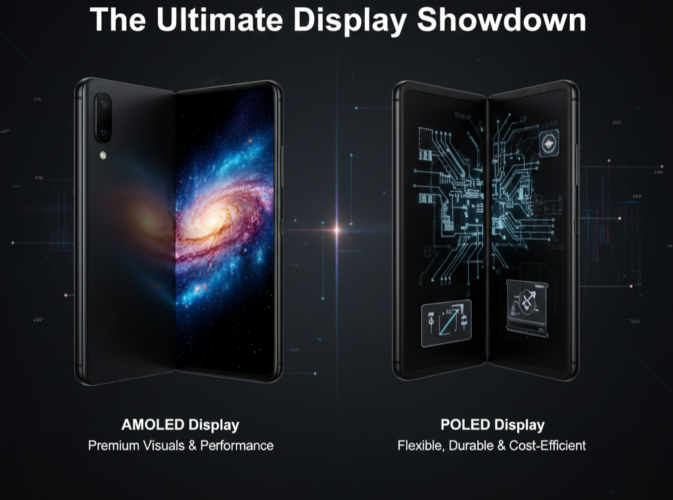
Display technology plays a central role in how we experience smartphones, tablets, and wearables. From scrolling through social media to watching HDR videos and gaming for hours, the quality of a screen can significantly shape everyday usage. Two terms that often come up in premium and mid-range devices are POLED and AMOLED. While they’re sometimes used interchangeably in marketing, they are not the same—and the differences matter.
This article takes a deep, practical look at POLED vs AMOLED displays, comparing their features, real-world performance, and overall value to help you understand which technology truly delivers the better experience.
Understanding the Basics of OLED Technology
Before comparing POLED and AMOLED, it’s important to understand what they share. Both are built on OLED (Organic Light-Emitting Diode) technology. Unlike LCD panels, OLED displays do not require a backlight. Each pixel emits its own light, allowing for true blacks, high contrast ratios, and improved power efficiency.
Where POLED and AMOLED diverge is not in whether they use OLED—but in how those OLED pixels are controlled and constructed.
What Is AMOLED?
AMOLED (Active Matrix Organic Light-Emitting Diode) uses an active matrix of thin-film transistors (TFTs) to control each individual pixel. This allows for precise brightness control, faster refresh rates, and better handling of complex visuals such as high-resolution video and gaming.
AMOLED has become the gold standard for smartphone displays, especially on Samsung devices, which dominate AMOLED production. The technology is mature, refined, and widely adopted across flagship and mid-range phones.
In practical terms, AMOLED displays are known for:
- Rich colors and high contrast
- Excellent outdoor visibility
- Smooth motion and responsiveness
- Strong support for HDR content
What Is POLED?
POLED (Plastic OLED) refers to OLED panels that use a plastic substrate instead of the traditional glass substrate found in standard AMOLED displays. This plastic layer makes POLED screens thinner, lighter, and more flexible.
POLED is most commonly associated with LG Display and is frequently used in curved or foldable designs. While POLED panels can also use active-matrix technology, the defining difference lies in the material composition, not the pixel-driving method.
This construction allows POLED displays to bend more easily, absorb impact better, and enable slimmer device designs.
Display Quality: Color, Contrast, and Sharpness

When comparing POLED vs AMOLED in terms of image quality, the differences are subtle but noticeable to trained eyes.
AMOLED displays typically deliver more vibrant colors with higher peak brightness. Samsung’s AMOLED panels are particularly known for excellent color calibration and industry-leading contrast ratios. Blacks are deep, whites are bright, and HDR content often looks more dramatic.
POLED displays, while still capable of excellent contrast and true blacks, can sometimes appear slightly less saturated. Color tuning varies widely depending on the manufacturer and calibration, meaning one POLED panel can look significantly better than another.
For users who prioritize cinematic visuals and punchy colors, AMOLED often holds the edge.
Comparison Table: POLED vs. AMOLED
| Dimension | POLED | AMOLED |
|---|---|---|
| Features | Flexible, lightweight, potential for curved designs | Vibrant colors, deep blacks, high contrast |
| Price/Value | Generally more expensive due to newer technology | Less expensive as it is more established |
| Performance | Good color accuracy and durability | Excellent color vibrancy, efficient power usage |
| Use Cases | Wearables, foldable phones, curved displays | Smartphones, televisions, tablets |
Performance and Responsiveness
Performance is another area where AMOLED tends to excel. Because AMOLED technology has been refined over many years, it typically offers:
- Faster pixel response times
- Better high-refresh-rate performance
- Smoother animations and transitions
POLED displays are no slouch, but the plastic substrate can introduce minor inconsistencies in uniformity or brightness, particularly at extreme viewing angles. These issues are usually subtle and may not be noticeable during everyday use, but they can matter to power users and gamers.
In fast-paced gaming or scrolling-heavy usage, AMOLED displays generally feel more polished.
Durability and Design Flexibility

This is where POLED clearly stands out.
Thanks to its plastic substrate, POLED is more resistant to shattering than glass-based AMOLED displays. While it can still scratch, it’s less likely to crack when dropped. This makes POLED particularly attractive for:
- Curved-edge phones
- Foldable devices
- Ultra-thin smartphone designs
AMOLED displays, being glass-based, are more rigid and more prone to cracking under impact. However, they are typically paired with protective glass layers that improve scratch resistance.
If durability and flexible form factors matter more than raw display performance, POLED offers a clear advantage.
Power Efficiency and Burn-In Risk
Both POLED and AMOLED benefit from OLED’s inherent power efficiency, especially when displaying dark content. However, AMOLED displays often manage power more efficiently at higher brightness levels due to better pixel control and refinement.
Burn-in remains a concern for all OLED-based displays. AMOLED panels generally have better pixel-aging management, thanks to longer development cycles and more advanced compensation algorithms. POLED displays have improved significantly, but long-term burn-in resistance can vary depending on usage patterns and panel quality.
For heavy users who keep static UI elements on-screen for long periods, AMOLED may provide better long-term reliability.
Cost and Value for Consumers
From a value perspective, POLED displays are often used to reduce manufacturing costs while enabling modern design features. This makes them common in upper mid-range devices that want premium aesthetics without flagship pricing.
AMOLED displays, especially those sourced from Samsung, tend to be more expensive. That cost is reflected in flagship pricing but also delivers consistently high-quality visuals and performance.
In short:
- AMOLED offers superior consistency and premium image quality
- POLED offers design flexibility and cost efficiency
The better value depends on whether you prioritize visual excellence or innovative form factors.
POLED vs AMOLED: Which One Should You Choose?

Choosing between POLED and AMOLED depends less on the name and more on how the display is implemented. A well-calibrated POLED panel can outperform a poorly tuned AMOLED display, but at the highest levels, AMOLED still sets the benchmark.
If you want the best possible display performance—especially for media consumption, gaming, and long-term reliability—AMOLED remains the safer choice. If you value lighter designs, curved or foldable screens, and solid durability at a lower cost, POLED delivers strong value.
Final Verdict
The POLED vs AMOLED debate isn’t about which technology is “good” or “bad.” It’s about trade-offs.
AMOLED excels in color accuracy, brightness, and refinement, making it ideal for premium smartphones and power users. POLED prioritizes flexibility, durability, and design innovation, making it a smart choice for modern, cost-conscious devices.
As display technology continues to evolve, the gap between the two is narrowing. For most users, both POLED and AMOLED offer excellent experiences—but understanding the differences helps you make a more informed buying decision.


Improve this guide




User forum
0 messages